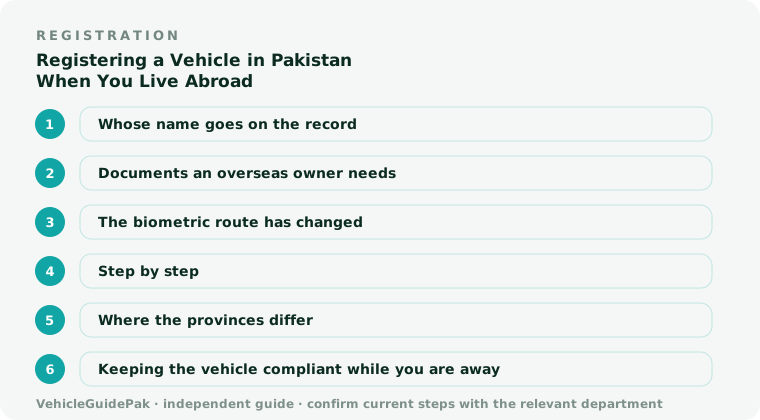
A Pakistani vehicle bought for family use often ends up registered in the name of the relative who drives it. That works until the car is sold, insured, challenged in a tax notice or divided in an inheritance. This guide is for Pakistanis living abroad and non-resident owners who want the vehicle in their own name, and for the family member acting on their behalf.
Whose name goes on the record
The excise department records an owner it can identify through a CNIC or NICOP and a biometric check. Living abroad leaves you on that record and changes how you prove who you are. Register the vehicle in your own name if you hold a NICOP, and use an authority letter or the digital verification route for the steps you cannot attend.
Putting the vehicle in a relative’s name creates a document that says they own it. If the relationship changes, the relative dies, or the vehicle is in an accident, the registered owner is the person the department and the courts will look for. Insurance claims can also fail when the policyholder and the registered owner are different people without a stated interest.
The exception is an import under a concessionary scheme. Customs documents for a gift or transfer-of-residence import name the person who may register the vehicle, and that name must match the application.
Documents an overseas owner needs
| Document | Why the office asks for it | Where it comes from |
|---|---|---|
| NICOP or valid CNIC | Identifies the owner and links to the NADRA record | NADRA, or the Pakistani mission abroad |
| Passport copy | Confirms residence abroad and the name spelling | Your passport |
| Photographs | File and smart card | Any photo studio, recent and plain background |
| Proof of address in Pakistan | Fixes the registering district | Utility bill, lease, registry or family address document |
| Purchase invoice or import papers | Shows how the vehicle was acquired | Dealer, auction, or customs clearing agent |
| Authority letter or power of attorney | Lets a representative sign and collect | Signed by you, attested where the province requires it |
| Biometric verification | Confirms the owner’s identity | PAK-ID app or a NADRA centre |
| Tax and challan status | Shows what must be cleared first | Provincial excise portal or office |
The name on the invoice and the name on the NICOP must match. A common failure is an invoice issued to a brother or a dealer because that person was at the showroom. The excise office records the buyer named on the purchase document, and changing it later needs a corrected invoice plus an explanation, which can take longer than starting again.
The biometric route has changed
Punjab’s excise department launched PAK-ID verification for vehicle registration and transfer in February 2026. The department’s position is that overseas owners no longer need to visit a mission, swear an affidavit or execute a power of attorney for ownership verification. Islamabad’s excise department introduced a similar facility through the PakID app, where the biometric record serves as proof of identity and a separate transfer order form is unnecessary. Both still require the owner’s signed transfer or purchase documents.
Not every district counter will accept an app record for every service. A first registration, a transfer from a deceased owner and a correction of particulars can follow different routes from a straightforward sale. Call the district office before you book a flight or courier original documents.
Outside Punjab and Islamabad, expect the office to ask for an authority letter or power of attorney attested by the Pakistani mission. Ask whether it also wants Ministry of Foreign Affairs attestation after the document reaches Pakistan.
Step by step
- Confirm the registering district. It normally follows the address on your CNIC or NICOP and the place where the vehicle will be kept, not the city where you bought it.
- Buy with the invoice in your own name. For an import, clear customs first and keep the bill of entry, goods declaration, bill of lading and duty receipts together.
- Prepare the identity documents. Check that your NICOP is valid, that the name matches the invoice exactly, and that any old CNIC number used on the file is explained.
- Choose the attendance route. Use PAK-ID where the province accepts it. Otherwise sign an authority letter naming the representative, the vehicle, the acts permitted and the validity period, then have it attested.
- Apply or book an appointment. Punjab and Islamabad accept online applications for several vehicle services through Dastak and the provincial portals; Sindh and KP still route much of the work through the district office or a regional directorate.
- Take the vehicle for inspection. The chassis and engine numbers are checked against the documents. A representative can present the vehicle, but the owner’s biometric record still has to be in the file.
- Pay the assessed fees and collect the receipt. The fee is calculated from vehicle value or engine capacity, plus advance tax, token tax and income tax where they apply.
- Collect the smart card and download the electronic card where offered. Check the name, CNIC or NICOP number and address before you file it away.
Where the provinces differ
Punjab runs registration at the district excise office and payment through an ePay Punjab PSID. Ownership verification through PAK-ID is the current route for overseas owners, and the department says a verified transfer can be completed within 48 hours once payment is made. A first registration still needs an inspection and a fee assessment.
Sindh registers through regional directorates in Karachi, Hyderabad, Sukkur, Larkana and Mirpurkhas. Registration fees are a percentage of vehicle value, from 1 percent for cars up to 1000cc to 5 percent above 2500cc. Some offices still issue a paper book alongside the smart card.
Khyber Pakhtunkhwa processes registration at the district motor registering authority. Expect a branch visit, a local attestation for any authority letter, and an inspection at the counter.
Islamabad uses Form F, a physical inspection and a fee formula of registration fee plus advance tax, token tax and income tax. A late fee starts after 60 days from the invoice date, which matters when documents arrive by courier.
Balochistan follows the district excise route with its own forms and fee schedule. Ask for the current list in writing, because requirements can vary between districts.
Keeping the vehicle compliant while you are away
Registration starts a yearly obligation. Token tax falls due against the vehicle, insurance has to be renewed, and challans attach to the registration number whether or not you were driving. Leave a named representative with a copy of the smart card, the tax receipts and the insurance policy, and written authority to pay and collect receipts.
If you sell while abroad, the buyer needs a transfer the excise office will accept. Use PAK-ID where it is available, or send an authority letter that specifically permits the sale and transfer. An open letter that says only “all matters” is often refused.
Review the record once a year. A wrong address can send the smart card to the wrong house, and an expired NICOP can stall the next transfer. Correcting either is easier before a buyer or a tax notice finds it.