A cleared import is legal to own but not yet legal to drive. Customs decides whether the vehicle entered the country correctly and whether duty was paid; the provincial excise and taxation department decides whether it can be registered, plated and taxed for road use. Buyers often treat the release order as the end of the process and discover at the excise counter that the file needs a document the clearing agent never handed over. This guide covers the second half, from the port file to a smart card in your name.
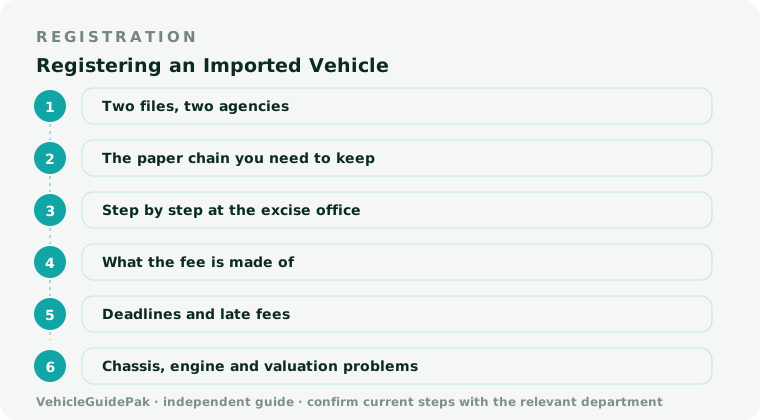
Two files, two agencies
The customs file ends with a release order that lets the vehicle leave the port. The registration file begins with an application to the excise and taxation officer in the district where the owner lives. The two files share documents, but neither agency completes the other’s work.
Customs checks classification, value and duty under the Customs Act, 1969 and the relevant import schedule. The excise department checks ownership, the duty-paid record, the vehicle’s identity and the provincial fee and tax position. A vehicle can be perfectly cleared and still be unregisterable for weeks because the invoice and the goods declaration disagree about the engine capacity.
The paper chain you need to keep
The clearing agent assembles most of this at the port. Keep your own copies, because the excise file needs them again and an agent’s file is not yours.
| Document | What it proves | Who issues it |
|---|---|---|
| Goods declaration, also called the bill of entry | That the vehicle was declared and assessed for duty | Customs, filed through WeBOC or the Pakistan Single Window |
| Bill of lading or airway bill | How and when the vehicle entered Pakistan | Shipping line or freight forwarder |
| Commercial invoice | The declared value and the vehicle’s specification | Foreign seller or dealer |
| Import permit or authorisation, where the scheme requires one | That the import was allowed under a particular route | The ministry or authority named in the scheme |
| Duty and tax payment evidence, including the PSID receipt | That assessed amounts were paid before release | Bank and customs system |
| Foreign registration document, for a used import | The vehicle’s previous registration and its identity details | The issuing authority abroad |
| Owner’s CNIC and address proof | Identity and the district that holds the registration | NADRA and a utility bill or rent agreement |
Islamabad’s registration page lists the bill of entry, bill of lading and the old registration book for an imported vehicle, alongside the CNIC, the application and proof of residence. Other provinces ask for the same core set and add local items, so treat the list as a starting point and confirm the district checklist.
Step by step at the excise office
- File the application with the excise and taxation officer for the district, attaching the customs papers and identity documents.
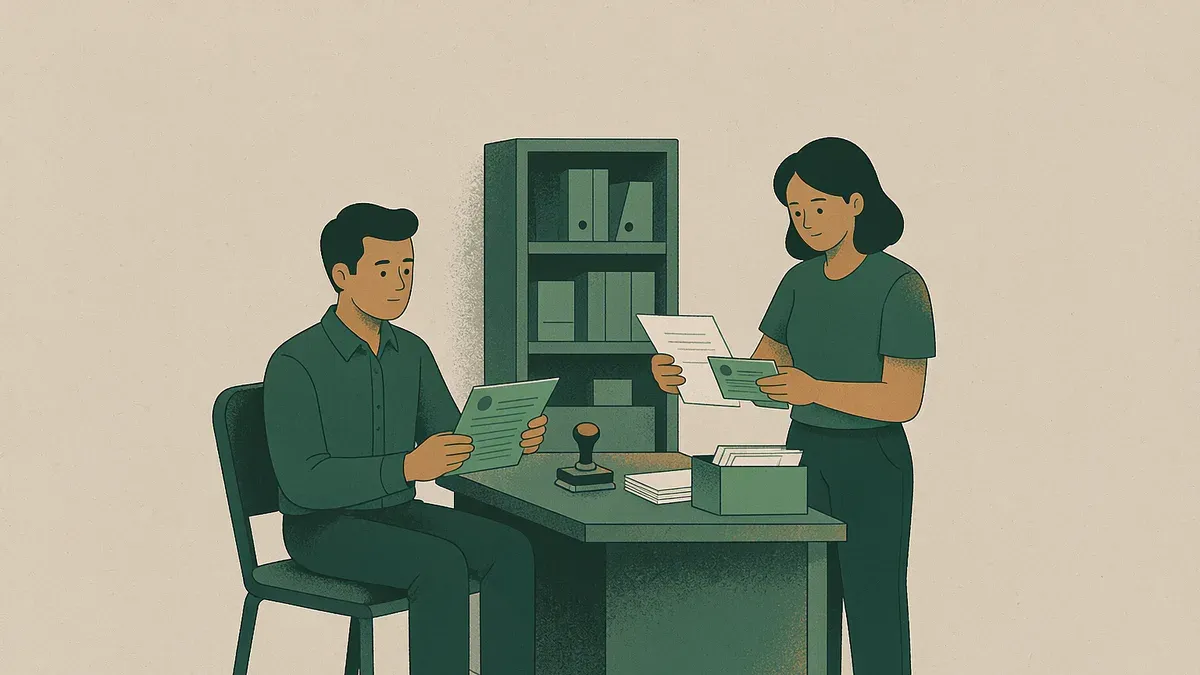
- Present the vehicle for physical inspection. The inspector records the chassis number, engine number, make, model and colour on the inspection form, which is Form F in Islamabad and an equivalent form elsewhere.
- Have the record entered at the data entry counter once the documents are accepted. The operator prepares the computerised form for your signature.
- Pay the assessed amounts at the counter or against the generated challan, and keep the receipt.
- Collect the registration number and plates, and the registration book or smart card when it is issued.
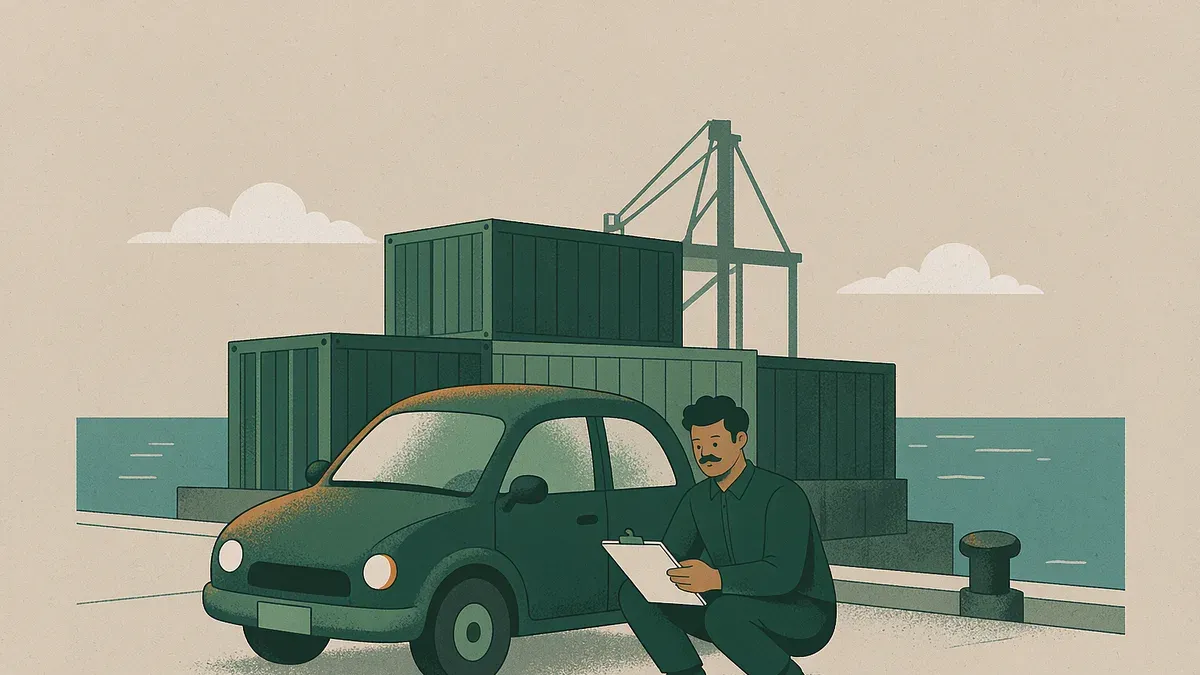
The inspection is where most imported files slow down. The inspector is comparing three things: the number stamped on the vehicle, the number on the goods declaration, and the number on the invoice and foreign registration document. Any difference becomes a query, and a chassis number that does not match the customs record can send the file back to customs for clarification before registration resumes.
What the fee is made of
Registration is not a single charge. Islamabad publishes the composition as registration fee plus advance tax, token tax and income tax, with professional tax added for a commercial vehicle. A special number, if you ask for one, is charged separately from the published schedule.
Token tax and income tax are assessed for the remaining months of the fiscal year, which runs from 1 July to 30 June, then renew annually. That is why two identical vehicles registered in different months can produce different first bills. The fee scale itself moves with engine capacity and vehicle category, and provinces revise their schedules, so ask the counter for the itemised breakdown rather than accepting a single total from an agent.
Deadlines and late fees
Islamabad applies a late fee once registration is delayed beyond 60 days from the invoice date. That clock starts with the invoice, not with the release order, so a vehicle that sat at the port or in a workshop can already be late on the day it reaches the excise office. Other provinces run their own deadlines, and some assess the delay from the date of arrival rather than the invoice.
Two other deadlines sit around the registration. Insurance must be in place before the vehicle is used on the road, and a port transit arrangement does not substitute for it. The annual token tax period then begins from the registration, so the first renewal falls due earlier than a full year in most cases.
Chassis, engine and valuation problems
Three faults recur in imported files.
A number mismatch between the vehicle and the customs record is the most serious. It can come from a typographical error at declaration, from a replacement engine fitted abroad, or from a cloned identity. The excise office will not register a vehicle whose identity does not reconcile, and the correction has to come from customs or from the foreign registration authority.
An undeclared modification is the second. A converted fuel system, a changed body type or a different seating capacity from the declared specification invites a fresh inspection and, in some cases, a revised assessment.
A valuation dispute is the third. Where the declared value looks low against the department’s own reference, the file can be held while the value is reviewed. That is a customs question, not an excise one, and the excise counter cannot resolve it. Keep the assessed value and the duty paid in writing so the two agencies are working from the same figures.
Province by province
| Province or territory | Where registration is filed | Local difference |
|---|---|---|
| Punjab | District excise and taxation office, with services listed on Dastak | Registration and token tax records are visible through the provincial vehicle information system |
| Sindh | Sindh Excise, Taxation and Narcotics Control district office | Biometric identity checks are used across vehicle services |
| Khyber Pakhtunkhwa | KP Excise, Taxation and Narcotics Control district office | Registration, smart card and e-payment are being consolidated under one system |
| Balochistan | Provincial excise office in the district | Fewer online steps, so expect to attend in person |
| Islamabad Capital Territory | Excise and Taxation Department | Itemised fee formula, 60-day late fee, doorstep and mobile registration options |
The district that holds the file is normally the owner’s district of residence, not the port of entry. A vehicle cleared in Karachi for an owner living in Peshawar is registered in Peshawar under Khyber Pakhtunkhwa’s schedule.
Used imports and concessionary schemes
A used import adds the foreign registration book and, where the vehicle came in under a transfer of residence, personal baggage or gift scheme, the documents that scheme required. Those schemes attach conditions to the vehicle, often a minimum holding period before it can be sold. Selling early can make the duty that was waived payable again.
Vehicles cleared under an investment or port-related concession carry similar conditions. The scheme rules typically require the registration to be reported back to the customs collectorate that cleared the vehicle, and restrict sale without prior approval. Read the scheme notification before buying such a vehicle second hand; the restriction travels with the vehicle.
Before you pay the clearing agent
Ask for the complete set: the goods declaration, the paid PSID receipt, the invoice, the bill of lading and, for a used vehicle, the foreign registration book. Check that the chassis and engine numbers match on every one of them, and check that the invoice date is recent enough to leave room before the registration deadline. A file assembled this way usually clears the excise counter in one visit, and it gives you the paper you need when you sell the vehicle later.