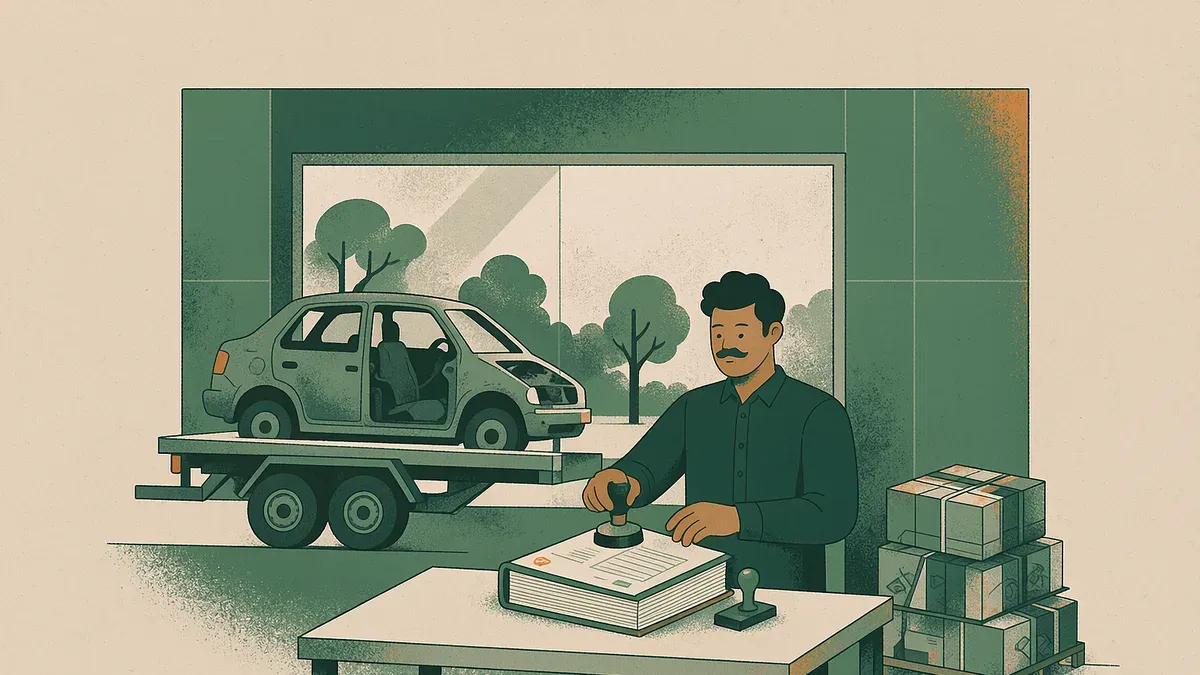
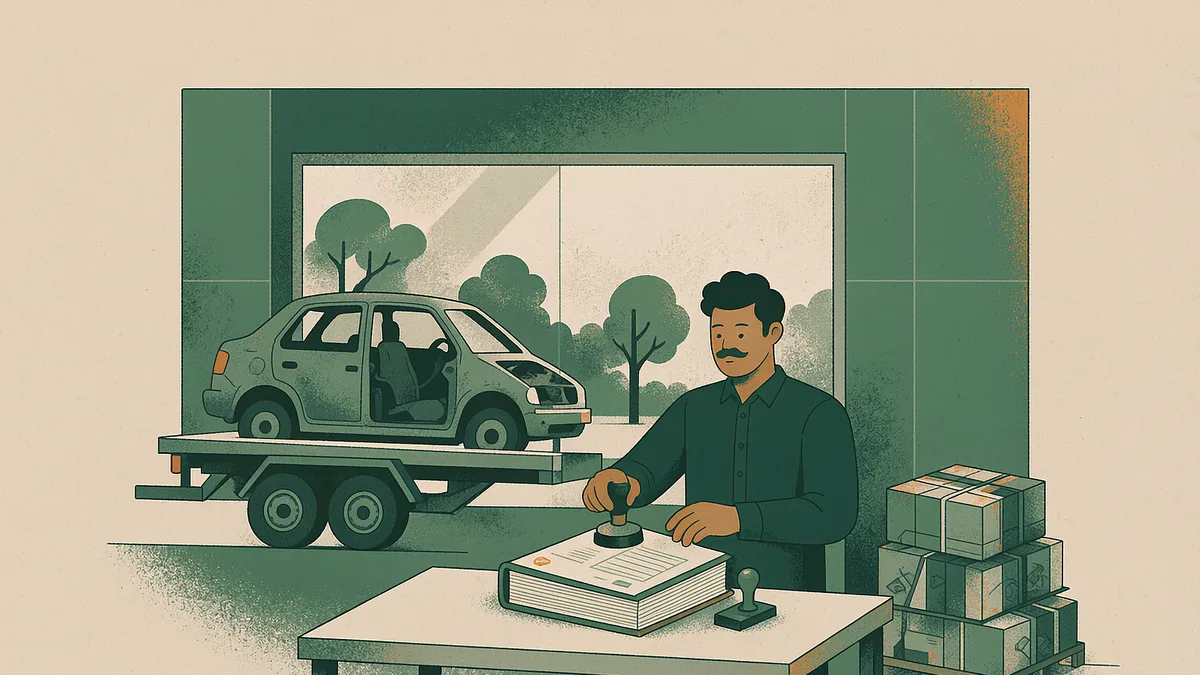
A vehicle that will never be driven again stays on the register until someone closes the record. Until then the token tax period keeps renewing, the plate stays attached to your CNIC, and tax notices for that vehicle keep arriving at your address. This guide covers cancellation of registration for vehicles being scrapped, written off after an accident or exported, along with the cases that look similar and the paper trail that decides whether the office accepts the file on the first visit.
Deregistration, transfer and a blocked record
Three different actions get described as removing a vehicle from your name. Each leaves the record in a different state.
| Situation | Correct action | Record afterwards |
|---|---|---|
| Sold, vehicle stays on the road | Transfer of ownership | Active, in the buyer’s name |
| Dismantled or scrapped | Cancellation | Entry removed |
| Total loss, beyond repair | Cancellation | Entry removed |
| Exported permanently | Cancellation | Entry removed |
| Stolen, not recovered | Police report, then a block | Frozen, still registered |
| Parked and unused | Declaration of non-use | Active, tax adjusted |
A sale is never a cancellation. The buyer needs the vehicle on the register to tax and insure it, and a seller who files for cancellation after a sale creates a new problem for both sides.
The grounds the law recognises
Section 35 of the Provincial Motor Vehicles Ordinance, 1965 sets out when a registering authority cancels a registration: the vehicle has been destroyed or rendered permanently incapable of use, or it has been permanently removed from the province. The owner must report the fact as soon as possible and forward the certificate of registration with any token or card issued for road use. Section 34 covers suspension, a temporary state that can become cancellation if it runs long enough.
That list is narrow on purpose. A vehicle you no longer want, or one parked for a year, does not qualify. Where the vehicle will return to the road, the tax rules provide another route: a declaration of non-use filed with the licensing officer, which can reduce or exempt the tax for the period off the road.
Documents to assemble
Requirements vary by office and reason. These are what is commonly asked, with the point where files fail.
| Document | What it establishes | Where files get stuck |
|---|---|---|
| Original registration book or smart card | Identifies the record | A photocopy is refused; a lost book needs a duplicate first |
| CNIC of the registered owner | Standing to apply | Name or CNIC does not match the excise record |
| Written application with the reason | Puts the request on file | Wording that matches no ground in section 35 |
| Both plates, plus the third where issued | Plates out of circulation | One plate missing with no police report |
| Scrapping certificate from the yard | Proves destruction | No chassis or engine number on it |
| Photographs before and after dismantling | Supports the certificate | Chassis number not visible in any frame |
| Shipping bill, bill of lading, customs papers | Proves permanent removal | Papers in the buyer’s or agent’s name |
| Paid token tax challan or clearance slip | Dues cleared | Arrears found at the counter, after queuing |
Step by step at the district office
- Confirm the office that holds the record. Registration sits with the district where the vehicle was registered, and an application filed elsewhere is returned. Punjab’s Dastak service lists registration, transfer and token tax but not cancellation, so the file is built at the counter.
- Clear the dues. Ask for a token tax status print and a challan check before writing anything, then pay what is outstanding. An arrear stops the file at verification, the slowest point to find it.
- Write the application against a ground. Give the registration, chassis and engine numbers, what happened and the dates. One paragraph is enough; the officer is matching your words to a section.
- Submit originals with a full set of copies. Ask the clerk to stamp your copy with the date and a diary number. That stamp is the only proof of when you applied.
- Present the vehicle if inspection is ordered. For a scrapped vehicle this can mean bringing the cut chassis or the shell on a trailer to the office or a nominated inspection point.
- Collect the cancellation order and read it at the counter. It should name the vehicle, the ground and the date.
- Recheck the record after a week or two. A letter that never reached the database leaves you where you started at the next tax cycle.
Scrapping and export: what the proof looks like
The dismantler’s certificate should carry the chassis number, engine number, date and the dealer’s identity. Photograph the vehicle before dismantling with the chassis plate readable, and again once the shell is cut. Keep the cut section until the order is issued. Do not hand the registration book to a yard that offers to process the file before it gives you the certificate, because without the book you cannot complete the cancellation or apply for a duplicate.
For an export, take the excise no-objection certificate first where the province requires one, ship the vehicle, then file cancellation with the customs-stamped export documents and the bill of lading. A vehicle that has left the country but stays on the register keeps accruing token tax, and the notices follow the registered owner.
Province by province
| Jurisdiction | Where the file goes | What to expect |
|---|---|---|
| Punjab | District excise and taxation office | Registration, transfer and token tax run through Dastak; cancellation needs the counter |
| Sindh | Regional directorate holding the record: Karachi, Hyderabad, Sukkur, Larkana or Mirpurkhas | Administered under the Sindh Motor Vehicle Taxation Act, 1958, with file-based verification |
| Khyber Pakhtunkhwa | District excise and taxation office | The province publishes its own schedules; cancellation is handled at the office |
| Islamabad Capital Territory | Islamabad Excise and Taxation Department | The department cancels records itself for long-defaulting vehicles, so check the status first |
| Balochistan | District excise office | No central online cancellation service could be confirmed; plan for in-person follow-up |
Where a fee applies it follows the provincial schedule, and no national figure is published. Ask at the counter and get the amount on a challan before paying an intermediary.
The schedules sit on the Dastak excise service list, the Sindh excise motor vehicle tax page, the KP excise motor vehicle tax page and the Islamabad excise site. None of the four lists cancellation as an online service.
What still goes wrong after the letter
- Token tax keeps appearing. The order was issued but the database was not updated. Follow up in writing with the diary number and order date.
- The vehicle was registered twice, often after re-registration in another district. Cancelling one entry does not clean the other.
- An heir applies before transmission is complete. The office will ask for succession papers before it accepts a cancellation.
- A buyer took the book and plates and stopped answering. The file then needs a duplicate book and a police report first.
Before you hand over the keys
- Photograph the vehicle, the plates and the chassis plate before dismantling starts.
- Get the scrapping certificate before the shell leaves the yard.
- Clear token tax and challans, and keep every receipt.
- File at the district that holds the record, and leave with a stamped copy.
- Check the online record two weeks later, then again at the next renewal date.
A stamped application, a certificate that matches the chassis number and a copy of the cancellation order are what close the file. Without them the tax notice keeps arriving for a vehicle that no longer exists.