Most learners prepare for the driving test by practising the mechanics of moving a car. The test also checks whether you read the road, use mirrors, signal at the right moment and understand the signs you passed on the way to the centre. This guide covers both parts of the test, the documents to carry, the mistakes examiners see most often, and what to do after a fail.
From learner permit to test date
You cannot sit the regular licence test without a learner permit. In Punjab the permit is issued through Dastak, which now carries the DLIMS services, at a published fee of Rs 500 for each vehicle category. The permit is valid for six months, and licensing centres require it to be held for at least 42 days before the regular test. The same figure has been the practice for years, although it has been adjusted for some schemes, so check the current position on your application.
Khyber Pakhtunkhwa uses a similar model through the licence branch, with a practice period of about 45 days. Sindh runs its licensing service through DLS, and Islamabad through its traffic police system. In every province, the practical test is taken in person at a licensing centre.
| Province | Where the learner permit is handled | Practice period before the test | Where the test is booked |
|---|---|---|---|
| Punjab | Dastak, with DLIMS records | 42 days | Licensing centre, through the application |
| Sindh | Sindh Police DLS | Confirm with the licensing office | DLS or the licence centre |
| Khyber Pakhtunkhwa | Licence branch | About 45 days | Licence branch |
| Islamabad | Islamabad Traffic Police system | Confirm with the centre | Traffic police licensing centre |
| Balochistan | District licensing authority | Confirm with the office | District licensing office |
What the sign test covers
The sign test is usually a computer-based set of multiple-choice questions, available in English and Urdu. It asks you to identify signs by shape and colour, explain what a signal means, and choose the correct action at a junction, a pedestrian crossing or a broken road marking. The questions come from the highway code used by the province, so the official sign chart and rule book are better preparation than a memory list from a driving school.
Signs fall into three groups that are easy to confuse under time pressure. A red circle tells you something is prohibited. A triangle warns of a hazard ahead. A blue rectangle or circle gives information or a mandatory instruction. Traffic lights, lane markings, hand signals and the meaning of a solid line belong in the same study session, because the test mixes them rather than asking about signs alone.
The pass mark is set by the licensing authority and can change. Aim to answer every question correctly rather than to clear a guessed threshold. The common failures are predictable: confusing a warning sign with a prohibition sign, reading the first few words of a question and choosing too early, and not knowing which vehicle has right of way at an unmarked junction.
The road test
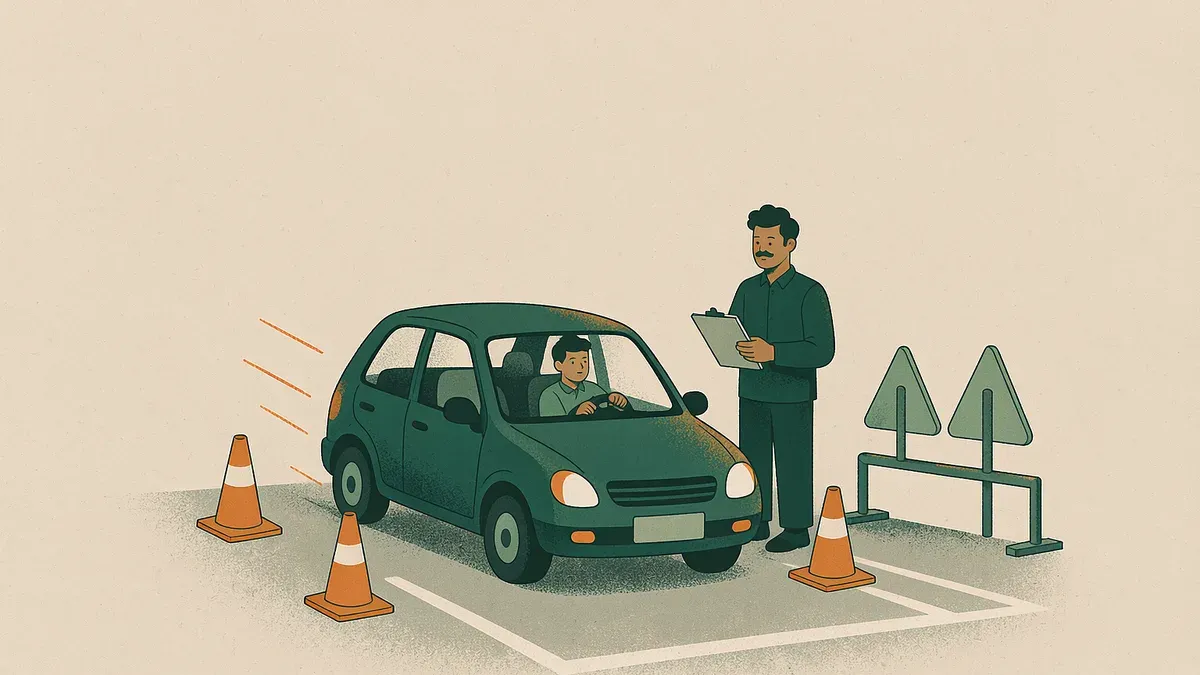
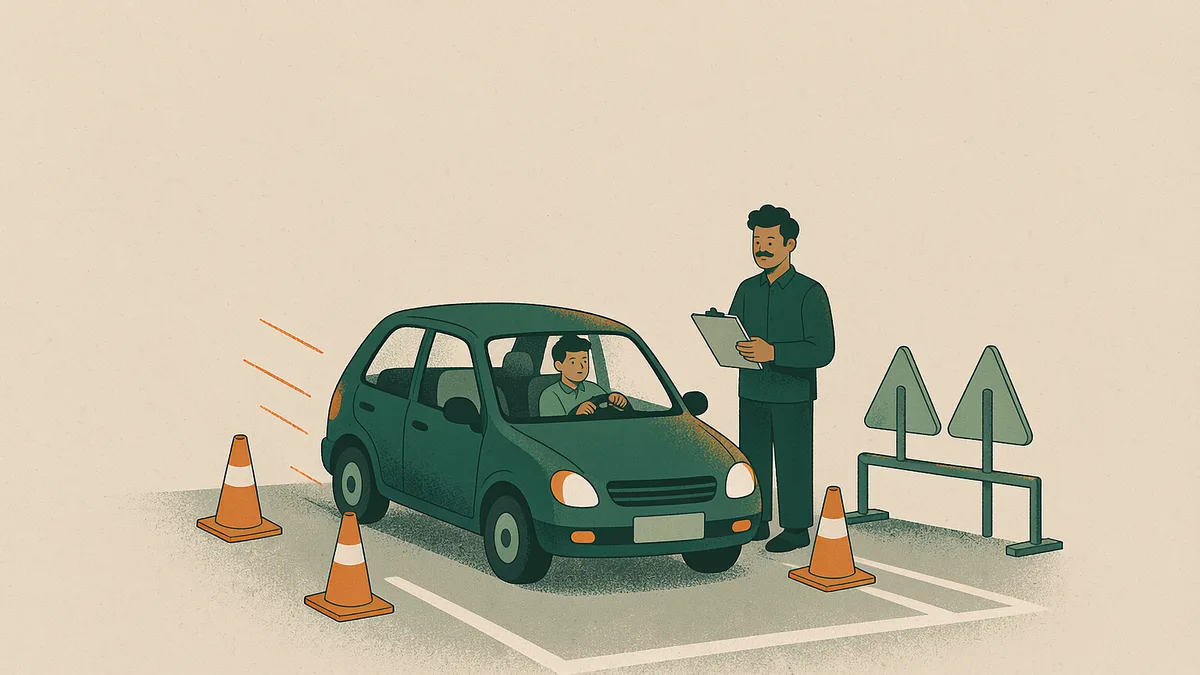
The road test is short and observed. The examiner checks your documents first, then watches how you prepare the vehicle, move off, drive in traffic, reverse and park. Different centres use different tracks, but the sequence is similar: a marked route, a reversing exercise, and a parking exercise between cones or lines.
| Stage | What the examiner watches | Common failure |
|---|---|---|
| Document check | Original CNIC, learner permit, fee receipt, medical certificate where required | Expired permit or a missing original |
| Vehicle check | Mirrors, seat, seat belt, lights, tyres, helmet where relevant | Moving off without adjusting mirrors or belting up |
| Move off | Clutch and accelerator balance, indicator, blind spot check | Stalling, or pulling out without a shoulder check |
| Road drive | Lane position, speed, following distance, signals, right of way | Rolling through a stop, wrong lane, late signal |
| Reverse | Mirror use, steering control, speed | Touching a cone or reversing without looking back |
| Parking | Alignment, spacing, brake control | Mounting the kerb or stopping too far from the line |
| Stop | Signal, mirror, handbrake, final position | Abrupt stop or no final observation |
A cone touch is treated as a loss of control in most centres, even when the rest of the drive was smooth. So is a missed mirror check before changing lane. Examiners watch for a driver who can be trusted when nobody is watching. Observation and control carry more weight than speed or confidence.
Documents and preparation on the day
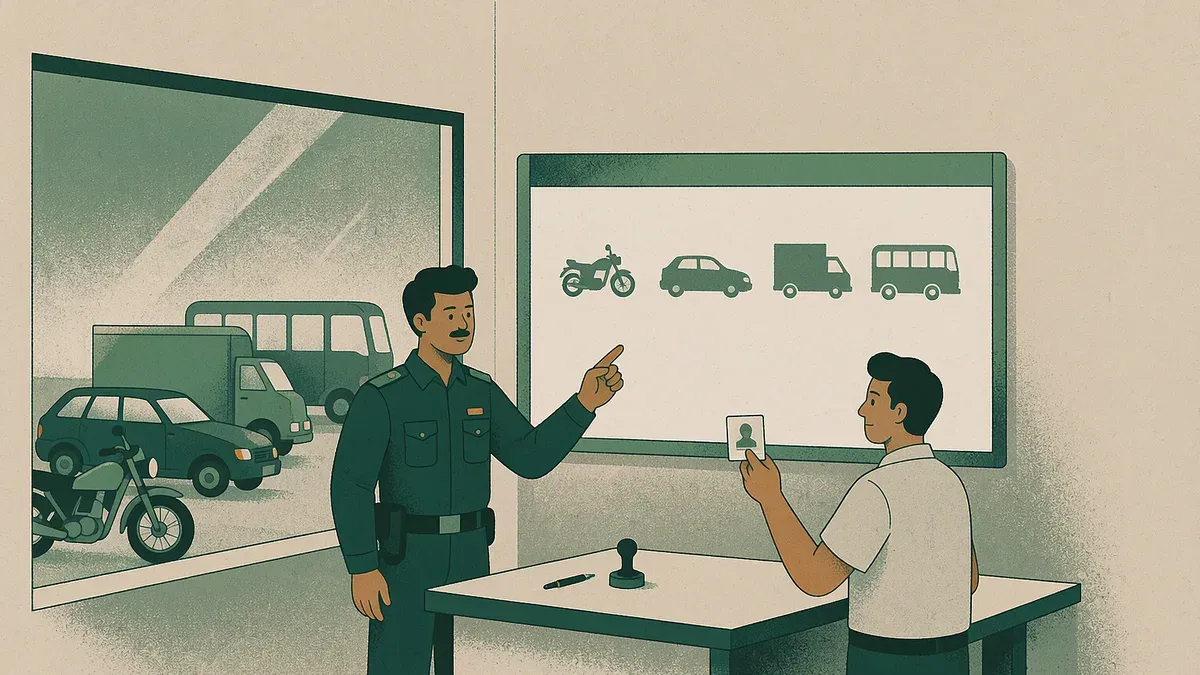
Carry the original CNIC, the learner permit, the fee receipt or PSID printout, and a medical certificate where the category or your age requires one. Take spectacles or contact lenses if your licence will carry a condition. For a motorcycle test, bring your own helmet and wear closed shoes.
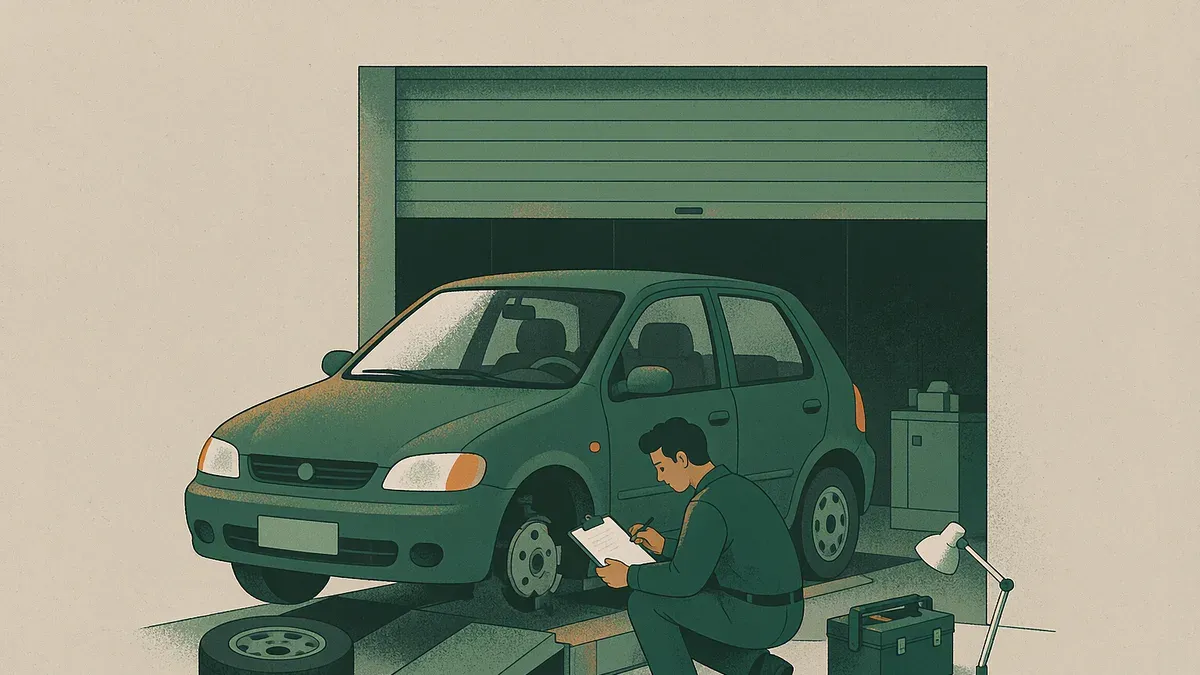
Arrive early enough to park, complete the counter formalities and walk the track if the centre allows it. Ask which vehicle you will use. If the test is taken in your own car, check the tyres, lights, horn and mirrors before you leave home. A defective brake light or a missing mirror can end the test before it starts.
If you fail
A failed sign test or road test is usually rebooked through the same licensing system after a short waiting period. In recent years Punjab has allowed a retake after about two weeks, compared with the older six-week gap. Confirm the current wait and the retest fee at the centre, because both are set by the licensing authority and can differ by district.
Do not let the learner permit expire while you wait. A permit that has run out cannot be used to book the test, and renewing it adds another step. If you fail the road test twice, ask the examiner what specifically cost you the pass. The answer usually points to observation, control or a document problem, and that is more useful than another hour of driving.
Practising in a way that matches the test
Drive the roads around the test centre, including the junctions and the roundabout you are likely to meet. Practise reversing into a marked bay using only the mirrors, then repeat it until you can do it without stopping to think. Practise a full stop at a stop line, a lane change with a mirror and shoulder check, and a hill start if your centre has a slope.
Learn the signs by shape and colour first, then by meaning. A red circle, a triangle and a blue rectangle are easier to remember than a list of individual pictures. Finish with the road markings and hand signals, which are the parts most learners skip.
On the day, narrate less and observe more. The examiner can see a mirror check; a comment about checking it adds nothing. A calm, deliberate drive with obvious observations passes more often than a fast, smooth one that misses the blind spot.