A registration book or smart card can carry the wrong version of your name for years without anyone noticing. The problem surfaces at the worst moment: when a buyer tries to transfer the vehicle, when an insurer asks whose policy this is, or when a checkpoint compares the document with your CNIC. Correcting the name is an amendment to a record that already exists, so the registration number stays the same and ownership does not move. The work is in proving what the correct entry should be and filing it with the district office that holds your vehicle file.
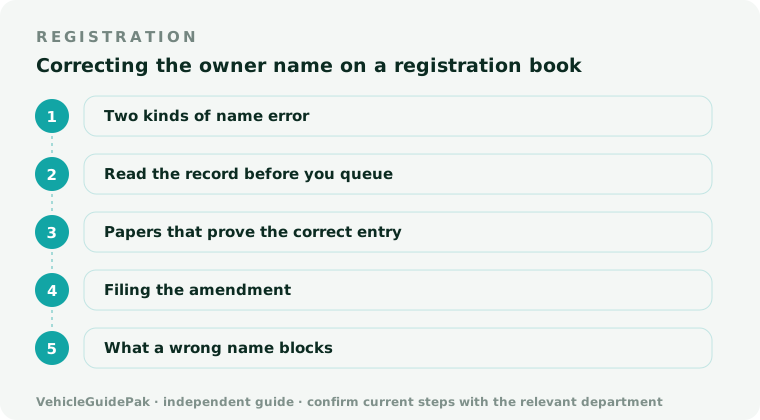
Two kinds of name error
The office treats these differently, and knowing which one you have decides the papers you carry.
A clerical error is a mistake made when the record was keyed in. The name is misspelled, the father’s name is wrong, a digit of the CNIC is transposed, or the Urdu and English versions do not match. Nothing about your identity has changed; the entry simply does not match the CNIC in front of the clerk.
An identity change is a real change in your legal name. Marriage, a court order, a corrected NADRA record or a renamed company all fall here. The record has to move from the old name to the new one, and the office needs the document behind the change.
Read the record before you queue
The card in your hand is a print of a database entry, and the database is what the department acts on. Pull the record first, either through your province’s vehicle verification service or by asking the counter to read it out, and write down the name, father’s name, CNIC number and address exactly as they appear.
Compare that entry with your CNIC character by character. Two outcomes are possible. If the database is right and only the printed card is wrong, you need a reprint rather than a correction, which is quicker. If the database is wrong, the amendment has to be processed before any new card can be printed.
Papers that prove the correct entry
| What is wrong | Document that proves the right entry | Who issues it |
|---|---|---|
| Spelling of your name | CNIC, passport or matric certificate | NADRA or the education board |
| Father’s name | CNIC or matric certificate | NADRA or the education board |
| Digits of the CNIC | Current CNIC | NADRA |
| Name used after marriage | Nikahnama plus the updated CNIC | Union council and NADRA |
| Name changed by court order | Certified copy of the decree | The court that passed it |
| Company or firm name | Incorporation certificate and board resolution | SECP and the company |
Every application also needs the original registration book or smart card, a copy of your CNIC, a written application, and in most districts an affidavit on stamp paper stating that the particulars you are asking for are correct. Where the error began with a dealer invoice or a sale certificate, ask the dealer for a corrected invoice as well, because the registration file still holds the original and staff will compare the two.
Filing the amendment
- Go to the district that registered the vehicle. Registration files sit with the district office, and a different district can usually only forward the papers, which adds weeks.
- Ask for the amendment application used for changes to registration particulars. Punjab and Islamabad both build the record on Form F, which the applicant signs to confirm the particulars, so the amendment repeats those same fields.
- Attach the proof from the table above, the affidavit, your CNIC copy and the original document. Carry the originals of everything you photocopy.
- Take the challan or payment slip the counter issues and pay it through the bank or the provincial payment system. Keep the paid receipt; it is the only proof that the file was accepted for processing.
- Attend the verification the officer sets. A name-only correction is usually checked against NADRA, while a file where the engine or chassis number is also in question may need the vehicle brought in for inspection.
- Hand over the old book or card if you are asked to, then check the new one field by field at the counter before you leave. A second error found at the counter is a five-minute fix; found at home, it is another application.
Note: Islamabad’s excise office publishes a processing fee of Rs 1,200 to Rs 3,000 for its counter services and quotes about four weeks for a transfer, so plan for a similar wait on a record amendment. The exact charge for your case appears on the challan, and it is set in the provincial schedule rather than nationally.
What differs by province
Punjab handles corrections at the district excise and taxation office, and several related services can be started through the provincial e-services portal before you visit. Sindh works through the district excise offices and the Civic Centre in Karachi. Khyber Pakhtunkhwa is moving its vehicle records onto universal number plates, smart cards and electronic payment, which shortens the gap between approval and card issue but does not remove the counter visit. Balochistan processes amendments at the district excise office that holds the file, and Islamabad routes them through the Motor Registration Authority at the excise office in H-9.
Across the provinces the sequence is similar: the file lives with the registering district, the correction is approved by an officer rather than a clerk, and the card is printed centrally after approval.
What a wrong name blocks
A buyer’s transfer application compares the seller’s name and CNIC against the record, and a name that does not match stops the biometric step. Insurance claims are examined against the policy holder and the registered owner, and an unexplained difference invites a delay at exactly the point where you need the money. Camera challans and token tax demands issued in the wrong name go to the wrong person, and older ones may follow the vehicle into the next owner’s file.
At a roadside check, a document that disagrees with the CNIC is treated as a possible tampering issue until it is explained. Carrying the acknowledgement slip for a pending amendment is a reasonable answer, but only if you actually filed one.
After the card arrives
Check the online record a week after collection, because the printed card and the database are updated at different points and occasionally one lags behind. Keep a photocopy of the corrected book at home and carry copies in the vehicle. If the error came from a dealer, send the dealer the corrected copy so their invoice records match.
Deal with the name before you advertise the vehicle. A correction filed during a sale holds up the buyer, and a buyer who cannot complete the transfer within the agreed time is entitled to walk away.