
Fitness
Vehicle Fitness Certificate Fee in Pakistan: How the Cost Is Put Together

Key takeaways
- The total combines an inspection charge, a certificate charge and sometimes a provincial levy.
- Each province sets and revises its own schedule of fitness charges.
- Commercial vehicles are charged and inspected more heavily than private cars.
- Always generate a PSID against your own registration number to confirm the figure.
A vehicle fitness certificate fee in Pakistan is not one flat price: it is assembled from an inspection or testing charge, a certificate issuance charge, and in some cases a provincial levy or service charge attached to the vehicle class. Because each province sets its own fitness charges and revises them from time to time, no single figure holds across Punjab, Sindh, Khyber Pakhtunkhwa, Balochistan and the Islamabad Capital Territory. What you can rely on is the structure, and knowing that structure lets you confirm the correct amount for your own vehicle before you travel to an inspection station.
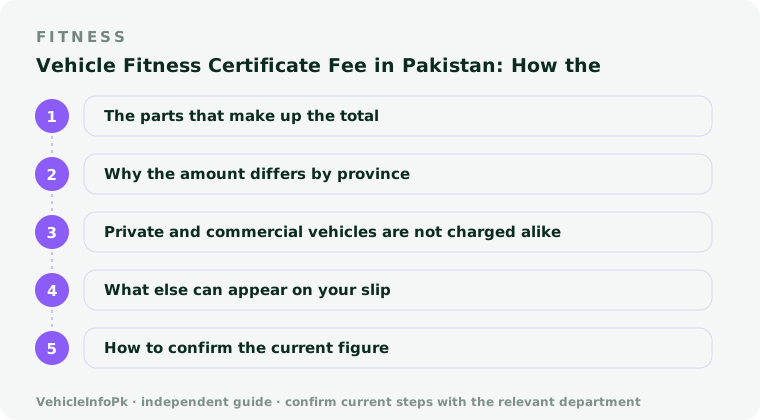
The parts that make up the total
When you receive a payment slip or PSID generated against your vehicle registration number, it normally reflects several components rather than a single line. Expect the following building blocks:
| Component | What it covers | Who usually decides it |
|---|---|---|
| Inspection or testing fee | The physical examination of brakes, lights, steering, tyres, emissions and body condition at a designated station. | Provincial excise and taxation department |
| Certificate fee | Issuance of the fitness certificate itself and its entry into the vehicle record. | Provincial excise and taxation department |
| Associated levy or service charge | Any additional provincial charge attached to certain vehicle classes or certain categories of service. | Province, sometimes with service-specific rules |
| Re-inspection or repeat visit charge | A further amount where a vehicle fails and must be presented again, depending on local practice. | The inspection station, following provincial rules |
Two vehicles of similar age can therefore carry different totals if one is a private car and the other a goods carrier, even at the same station.
Why the amount differs by province
Vehicle taxation and certification are provincial subjects, so each province publishes its own schedule of charges and adjusts it through its own budget process. A second reason is that inspection infrastructure is not identical everywhere: some provinces operate dedicated testing stations with equipment, others rely on manual examination by inspectors, and the cost of running each arrangement differs. A third reason is policy — a province may deliberately charge less for a category it wants to encourage, or add a charge for a category it regulates more tightly.
A figure quoted online for one province should never be assumed to apply in another. Even within a province, the schedule can be revised between one budget year and the next, so the safe assumption is always that the current figure is the one printed on your own generated slip.
Private and commercial vehicles are not charged alike
The clearest division in any fitness schedule is between private and commercial use. Commercial vehicles — buses, vans, coaches, taxis, rickshaws, trucks and other goods carriers — bear higher inspection costs and stricter inspection standards, because they carry passengers or freight for hire, accumulate far more road wear, and are more exposed in accident terms. A private car used by its owner sits at the lighter end of the scale. Vehicle weight class, seating capacity and age can each shift the figure further, so a heavy goods vehicle and a light commercial pickup will not sit at the same point on the same schedule.
What else can appear on your slip
Sometimes the amount generated is larger than the fitness charge alone because something else on the vehicle record needs settling first. Common additions include outstanding token tax periods, arrears carried from an earlier year, a surcharge applied after expiry, and route permit dues for commercial operators. The registration authority will generally not progress a certification while the vehicle record shows unpaid government dues, so it is worth clearing these deliberately rather than discovering them at the counter.
How to confirm the current figure
- Generate the payment slip or PSID against your own registration number through the provincial portal or the designated bank channel, rather than trusting a printed figure from another vehicle.
- Check the department's published schedule of charges for the current financial year, and note the date it was last revised.
- Confirm at the inspection station whether any re-presentation charge applies in your case, especially after a failed inspection.
- Ask whether arrears or permit dues have been bundled into the slip, and settle them in the same transaction so the record is clean.
- Keep the paid receipt with the vehicle documents; it is commonly checked at inspection and again at collection.
Generate the slip against your own registration number before you set out, since that document carries the amount actually due for your vehicle class and province. If the printed total includes items you did not expect, ask the counter to explain each component before you pay.
Keep reading

How to Apply for a Vehicle Fitness Certificate in Pakistan: Documents, Fee, Inspection and Collection
Apply for a Pakistan vehicle fitness certificate with confidence: documents, fee payment, inspection booking, test day and refusal reasons explained.

Vehicle Fitness Certificate in Pakistan: What It Is, Who Needs One and How It Differs From Registration and Token Tax
A vehicle fitness certificate proves roadworthiness. Learn who needs one in Pakistan, how long it stays valid, and how it differs from token tax.

Fitness Certificate Validity in Pakistan: How Long It Lasts and When It Starts
Fitness certificate validity is set by the authority and differs by class and province. Learn when it starts, when it ends, and the expiry gap.