
Token Tax
Token Tax in Pakistan: What It Is, Who Pays and How It Is Calculated
Key takeaways
- Token tax is an annual provincial charge on the vehicle, not a one-time registration fee.
- The charge is graded by vehicle category and engine capacity or size.
- Unpaid periods block transfers and fitness certificates and attract challans.
- Confirm current rates with your provincial department before every payment.
Token tax is the annual road tax that a registered vehicle owner in Pakistan pays to the provincial excise and taxation department, and it is charged on the vehicle rather than on the person driving it. It falls due once a year and is separate from the one-time registration charges and from a transfer fee. This guide explains what the tax covers, who is responsible for it, how the charge is worked out in principle, and why a paid record matters when you transfer a vehicle or apply for a fitness certificate.
What token tax actually is
Token tax is a recurring provincial charge for keeping a vehicle registered for road use. Paying it produces a record against the vehicle's registration for that period, historically shown as a token on the windscreen and now held in the department's database. Not paying it leaves the vehicle unpaid on the record, whether or not it is being driven.
It is worth separating token tax from the charges people confuse it with. Registration charges and the transfer charge are event-based: they are paid when the vehicle is first registered or when ownership changes. Token tax is period-based: it comes round every year for as long as the vehicle stays registered.
Who pays it and when it falls due
The registered owner is the person the department looks to, because the demand is raised against the registration. Where a vehicle has been sold but the transfer was never completed, the demand still reaches the previous owner, which is one of the strongest reasons to finish a transfer promptly.
The tax is annual. Provinces set their own financial-year or calendar-year cycle for collection, and the due date follows that cycle, so confirm which period your province is currently collecting for. Payment for a period can usually be made in advance or during the period itself; leaving it to lapse simply adds an unpaid year to the record.
How the charge is calculated
Each province publishes its own rate schedule, and that schedule is the authority on the amount. What is consistent across provinces is the structure of the calculation:
- Vehicle category. Private cars, motorcycles, commercial goods vehicles and passenger transport vehicles each sit in a different band.
- Engine capacity or size. For private cars the schedule is usually graded by engine capacity, so a larger engine falls into a higher band. Motorcycles are graded differently, and commercial vehicles are often graded by weight or by seating capacity instead.
- The period being paid. Paying for a single year costs less than clearing several years at once, because arrears accumulate year by year.
- Any surcharge for delay. Where a period has lapsed, the department applies its published late element on top of the base charge.
Rates are revised, and they differ between Punjab, Sindh, Khyber Pakhtunkhwa, Balochistan and the Islamabad Capital Territory. Never rely on a figure quoted by a dealer or in a social media post. Confirm the current schedule with your provincial department or through its official payment channel before you pay.
Why token tax status matters
Token tax is not only a tax question; it is a record question, and the record is checked at several points.
- Transfer of ownership. Outstanding token tax normally has to be cleared as part of the transfer file, so an unpaid period becomes the buyer's problem at the counter.
- Fitness certificate. Commercial vehicles and older vehicles in several provinces need a fitness certificate, and a paid token tax position is part of that check.
- Roadside checks and challans. Traffic police can verify the paid status of a vehicle during enforcement, and an unpaid record leads to a challan against the registration.
- Sale value. A buyer who checks the record and finds arrears will usually deduct them from the price, or walk away.
Keeping the payment receipt or the paid challan for each year gives you a file that answers all of those checks. A vehicle with a complete payment history is simply easier to sell, transfer and keep on the road.
Look up your vehicle's current token tax position through your provincial department's official channel, note which period is outstanding, and clear it with the receipt kept on file. Owners who check once a year rarely face a surprise at the transfer counter.
Keep reading
How to Pay Token Tax in Pakistan: Branch, Online Banking and Portal
Pay token tax in Pakistan by bank payment slip, online or mobile banking, or the provincial portal. Always keep the paid challan as proof of payment.
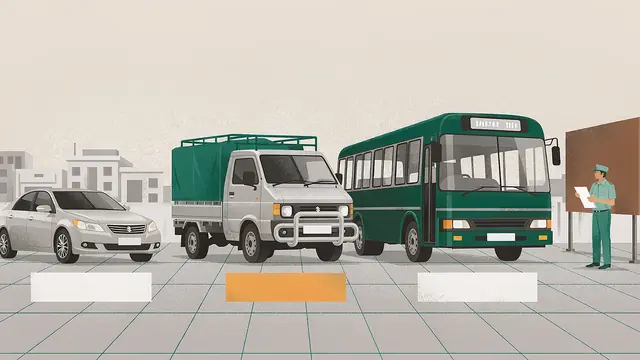
Token Tax Categories in Pakistan: Private, Commercial and Public Transport Vehicles
Token tax categories in Pakistan split private, commercial and public transport vehicles into separate provincial schedules with different annual rates.
Late Token Tax Penalty in Pakistan: Arrears, Surcharge and Clearing Your Record
Late token tax arrears stay on the vehicle record until cleared. Learn where unpaid dues surface, then how to settle them and fix the record.