
Verification
Which Documents and Numbers You Need Before a Vehicle Verification
Key takeaways
- Three keys drive every check: registration number, owner CNIC and chassis number
- Read stamped numbers off the vehicle before comparing them to the paperwork
- A missing registration book can be replaced; a missing CNIC blocks ownership checks
- Treat mismatched chassis or engine numbers as a reason to stop and investigate
A vehicle verification in Pakistan runs on three pieces of information: the registration number on the plate, the CNIC of the person recorded as owner, and the chassis or engine number stamped on the vehicle itself. You need the registration number to pull the record, the CNIC to confirm who that record is attached to, and the stamped numbers to confirm that the vehicle standing in front of you is the one the record describes. Most failed or inconclusive checks trace back to one of these being missing or transcribed wrongly.
The core documents and numbers you need
Before you open a provincial vehicle verification portal or walk into an excise and taxation office, have these to hand. The first three are enough for a basic ownership lookup; the rest matter once money or a transfer is involved.
| Item | Where you find it | What it unlocks |
|---|---|---|
| Registration number | The number plate, and the registration book or smart card | The single vehicle record |
| CNIC of the recorded owner | The owner's identity card, or the owner page of the registration book | Confirmation of who the record belongs to |
| Chassis number | Stamped on the frame, printed in the registration book | Matching the physical vehicle to the record |
| Engine number | Stamped on the engine block, printed in the registration book | A second physical match, useful where the chassis plate is damaged |
| Token tax receipt | Paid receipt, or the tax record on the portal | Whether annual dues are current |
| Fitness certificate | Issued by the provincial inspection authority | Required checks for commercial and older vehicles |
Why each one is asked for
The registration number is the index key. Provincial databases are organised around it, so almost every lookup — online or at a counter — begins there. The CNIC is the identity key: it is what links a vehicle to a person, and it is the only way to tell whether the person selling you the vehicle is the same person the record names.
The chassis and engine numbers are the physical keys. Everything else can be printed convincingly on paper, but the stamps on the vehicle cannot be moved between vehicles without leaving evidence. A verification that stops at the registration number tells you what should be standing in that compound; comparing chassis numbers tells you whether it actually is.
Token tax and fitness records are asked for because they show standing obligations. A vehicle with unpaid annual tax carries arrears that follow the vehicle, not the seller.
Reading the numbers off the vehicle
Read the numbers from the vehicle first, then check them against the paperwork, not the other way round. Doing it in that order stops you from reading what you expect to see.
- Photograph the chassis stamp and the engine stamp in daylight before comparing anything.
- Compare all seventeen characters of a chassis number, not just the visible few — single-digit errors are common in older paper records.
- For motorcycles, check the frame location given in the registration book; it varies by make, and a punch mark in an unusual place deserves a second look.
- Ask someone else to read the number aloud while you follow the printed entry, which catches transposed characters.
When a document is missing
A missing registration book is a normal starting point, not a dead end. A duplicate can be applied for at the registration authority that issued the original, using the CNIC and whatever identifying details are available, and the process usually involves an affidavit and a public notice period. Until it is replaced, you can still verify the vehicle through a registration number lookup or a CNIC-based search in provinces that offer one.
A missing CNIC is a harder stop. Without the identity number recorded against the vehicle, an ownership check gives you the vehicle but not the person, which is precisely the gap a buyer cannot afford. Treat it as a reason to pause rather than a formality to be waived.
When the numbers do not match
A mismatch between any two of the three keys should stop the transaction where it stands. The likely explanations range from benign to serious: a transcription error made decades ago when a handwritten record was entered into a database, a replaced engine that was never recorded, or a vehicle assembled from parts of more than one.
A single mismatched digit is usually a clerical error, and it can be corrected at the registration authority. A chassis number that does not correspond to any record, or one whose stamp looks disturbed, is not a clerical matter — take the details to the provincial excise and taxation department or the traffic police rather than negotiating it privately with the seller.
Ask the seller to explain the discrepancy in writing and dated, and ask them to accompany you to the registration authority to have the physical numbers inspected. A seller confident in the vehicle has no reason to decline.
Gather your registration number, CNIC and chassis number before you begin, and if any of the three is unavailable, resolve that first — the rest of the verification is built on top of them.
Keep reading
How to Verify Vehicle Ownership Online in Pakistan
Verify vehicle ownership online by registration number: see what the provincial lookup returns, which fields to match, and what the result means.
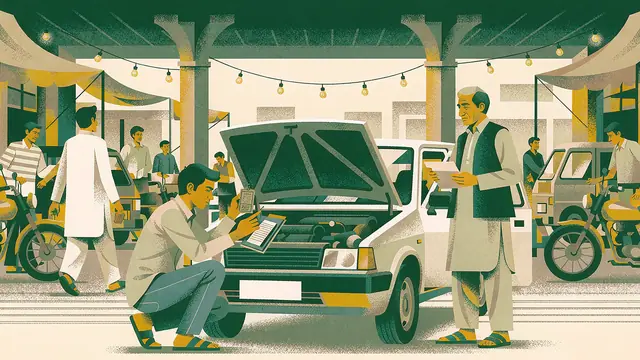
How to Verify a Used Car Before Buying in Pakistan
Before you pay for a used car: documents, engine and chassis number matching, verification lookup, token tax status, seller CNIC and sale letter.
Vehicle Verification for First-Time Buyers: When to Check and What
Verifying a used car in Pakistan: check before the booking amount, then again before the balance. A sequence for first-time buyers.