
Token Tax
Token Tax Exemptions in Pakistan: Categories, Claims and Limits
Key takeaways
- Exemption categories are published by each province and differ across Pakistan.
- Exempt and reduced-rate are different outcomes; check which the category grants.
- Keep paying while a claim is pending, or the period shows as unpaid.
- Exemption covers token tax only, not registration, transfer or fitness duties.
Token tax exemption in Pakistan is granted to specific categories of owner and vehicle that each provincial excise and taxation department publishes in its own schedule, rather than being a general right. Common published categories include certain agricultural vehicles, government and diplomatic vehicles, and vehicles registered to differently-abled owners, but the qualifying conditions differ by province. This guide explains the categories that generally appear, how exemption is claimed, and why eligibility is a decision the department makes rather than an assumption an owner can make.
Categories that may qualify
| Category | Basis of the claim | What usually decides it |
|---|---|---|
| Agricultural vehicles | Used for farming rather than general road transport | Vehicle class, use and supporting certification |
| Government vehicles | Owned by a government department or body | Ownership record and departmental certification |
| Diplomatic and consular vehicles | Registered to a mission or accredited staff | Diplomatic status and registration route |
| Differently-abled owners | Owner's disability status and personal use | Disability certification and vehicle specification |
| Specified public service vehicles | Ambulances, fire and certain public service uses | Body type and operator status |
Exemption and reduction are different things. Some categories are exempt from the charge entirely, while others pay at a reduced rate, and some are exempt only from part of the charge. The schedule published by your province is the authority on which applies.
How exemption is claimed
- Confirm the category exists in your province. Categories are not uniform across Punjab, Sindh, Khyber Pakhtunkhwa, Balochistan and the Islamabad Capital Territory.
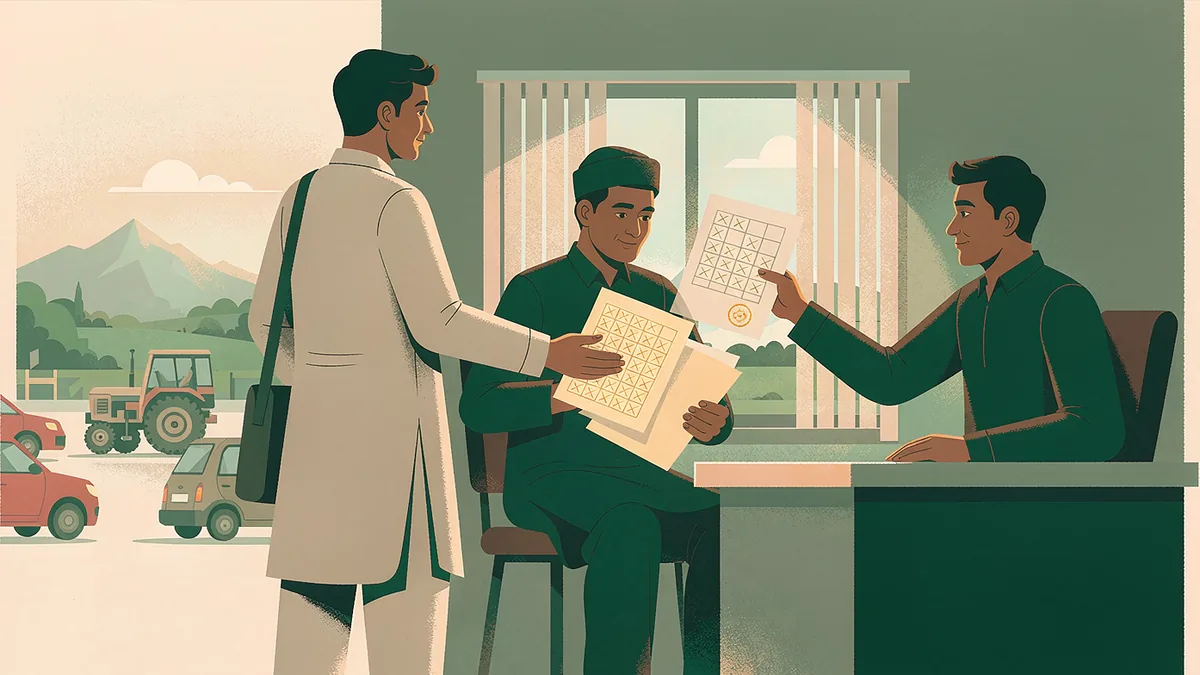
- Gather the supporting certificate. This is normally a government-issued certificate: a disability certificate, an agricultural or departmental certification, or documentation of diplomatic status.
- Apply at registration, or at renewal. Exemption is usually recorded at first registration, and then re-verified at renewal or at transfer. A vehicle already registered in a private name generally needs a fresh application rather than a simple note.
- Obtain the decision in writing. Ask for the exemption, or the reduced rate, to be reflected on the vehicle record and keep the order or receipt.
- Re-verify when anything changes. A change of owner, vehicle class or use can end the exemption.
Where exemption is granted for a period rather than permanently, diarise the renewal date. An expired exemption reverts the vehicle to the standard charge, and the gap then appears as an unpaid period on the record.
What exemption covers and what it does not
An exemption applies to the token tax charge. It does not remove the other obligations that come with keeping a vehicle on the road. Registration, transfer of ownership, a fitness certificate where required, insurance and traffic rules all still apply, and a challan issued for a traffic offence is not affected by tax status.
Exemption is also tied to the use the claim was based on. A vehicle exempted as an agricultural vehicle that is then used as a general commercial transport no longer matches the basis of its own claim, and the department can withdraw it.
Eligibility is decided by the department, not assumed by the owner. Holding a disability certificate, or working in farming, does not by itself exempt a vehicle: the certificate has to be presented, the vehicle has to match the category, and the department has to record the exemption against the registration.
Cautions before you claim
- Do not stop paying while a claim is pending. Until the exemption appears on the record, the period is treated as unpaid and arrears build up.
- Do not rely on an agent who says a category can be arranged. Exemption follows published criteria and a departmental decision; anything offered outside that is not valid.
- Keep the certificate current. An expired supporting certificate ends the basis for the exemption.
- Expect the record to be checked at transfer. An exempted vehicle changes hands under the same rules as any other, and the buyer may not qualify for the same category.
- Check the current schedule. Categories, conditions and rates are revised, and a category that applied last year may have been narrowed.
Ask your provincial excise and taxation department which exemption categories it currently publishes, what certificate each requires, and whether the exemption will be recorded on the vehicle record. Apply before the period falls due, and keep the decision in writing with your vehicle papers.
Keep reading
Token Tax in Pakistan: What It Is, Who Pays and How It Is Calculated
Token tax in Pakistan is the annual provincial road tax on a registered vehicle, charged by engine size or category. Rates differ in every province.
How to Pay Token Tax in Pakistan: Branch, Online Banking and Portal
Pay token tax in Pakistan by bank payment slip, online or mobile banking, or the provincial portal. Always keep the paid challan as proof of payment.
Token Tax Categories in Pakistan: Private, Commercial and Public Transport Vehicles
Token tax categories in Pakistan split private, commercial and public transport vehicles into separate provincial schedules with different annual rates.