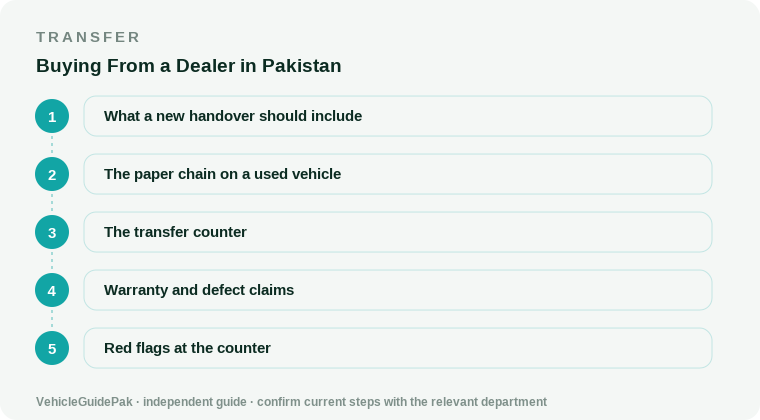
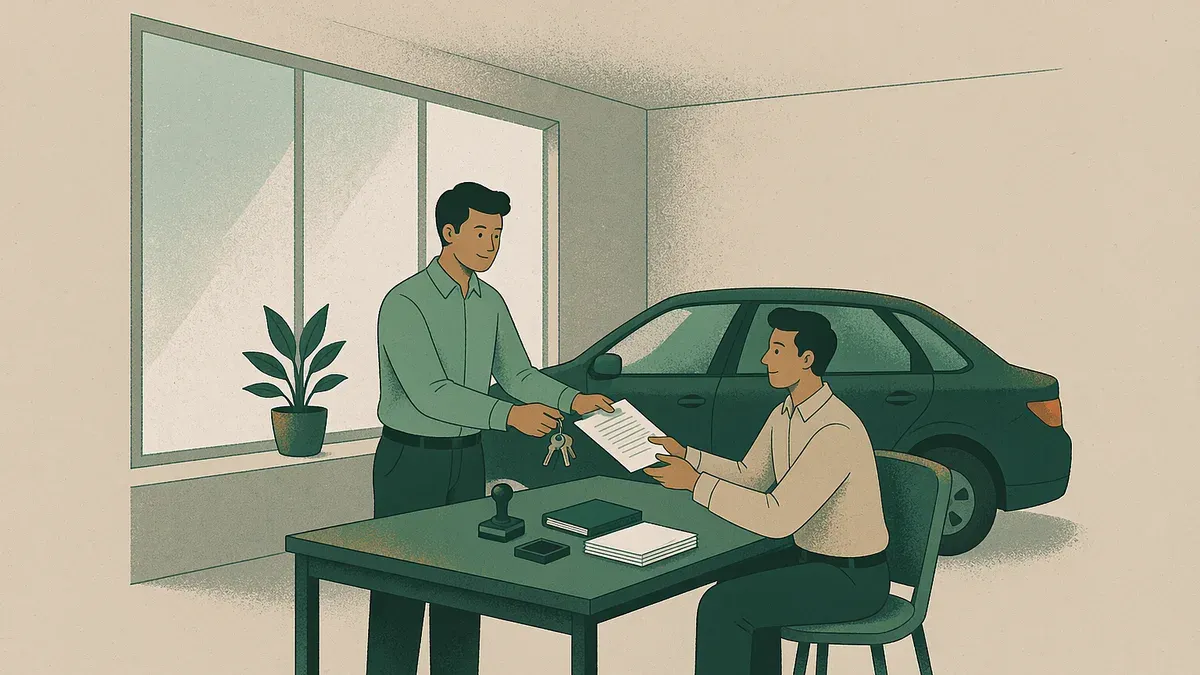
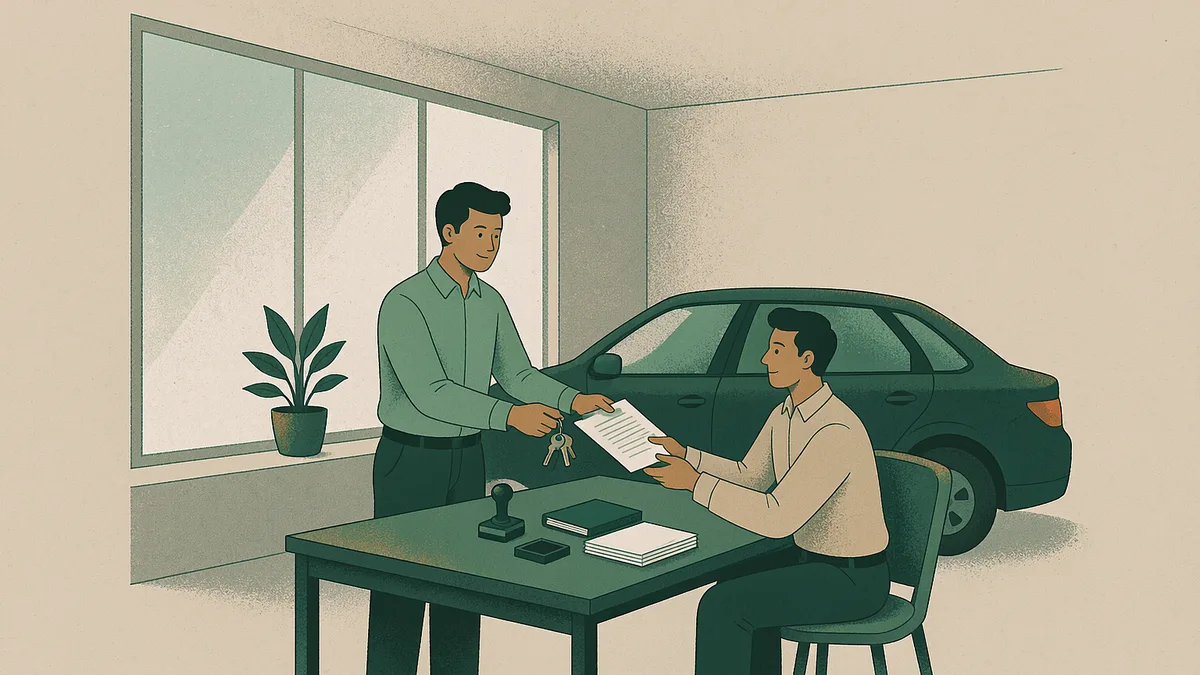
A dealership sits between the buyer and the registered owner, and the paperwork has to show that chain. This guide covers what an authorised dealer should hand over with a new vehicle, what a used-car dealer must produce before a transfer can clear, and how a warranty claim survives the drive home.
What a new vehicle handover should include
Punjab lets licensed dealers register new vehicles through the Dealer Vehicle Registration System, with the dealer entering the data, depositing the government dues and issuing plates at the showroom. The dealer is licensed under the Punjab Motor Vehicle Transaction Licensees Act 2015, and that licence is valid for one year.
The Act sets obligations a buyer can check. A licensee must keep a record of every transaction, display the rates it charges, and stay within the maximum service charge set by government. The licensing authority can cancel a licence where the dealer negotiated a transaction knowing there was a defect or dispute in the identity or title documents, charged above the prescribed rate, or misplaced the documents handed over for a transaction. The penalty runs to six months’ simple imprisonment or a fine of forty thousand rupees, or both.
Khyber Pakhtunkhwa regulates dealers through a separate ordinance. The provincial excise page reproduces the 1983 ordinance, which requires a dealer to hold a registration certificate, renewed annually, and to keep accounts and records for inspection. It also allows cancellation where a dealer negotiated a sale knowing there was a defect in title, and caps the commission a dealer may charge.
Ask to see the licence or registration certificate, and check that the service charge on the invoice matches the rate displayed in the showroom. In Sindh and Balochistan, ask the district office whether the dealer can submit the file.
| Item | New vehicle from a dealer | Used vehicle from a dealer | What to check |
|---|---|---|---|
| Invoice | Dealer’s invoice in the buyer’s name | Dealer invoice with the owner’s sale letter attached | Chassis and engine numbers match the vehicle |
| Sale certificate | Manufacturer or dealer certificate | Often replaced by a sale deed or transfer order | Date, price and both names are filled in |
| Form F | Prepared by the dealer, signed by the buyer | Signed at the excise office | Never sign a blank form |
| Transfer deed | Not needed on a first registration | Registered owner’s signature required | Compare the signature with the CNIC copy |
| Token tax | First period paid with registration | Clearance up to the current period | Keep the paid challan |
| Warranty | Manufacturer booklet in the buyer’s name | Balance may transfer, subject to conditions | Service history and written confirmation |
The paper chain on a used vehicle
A used-car dealer is usually an intermediary. The registered owner remains the person on the record. The transfer needs the owner’s signature on the transfer deed and the transfer order form, plus CNIC copies of the owner and the buyer, the registration book or smart card and proof that token tax is clear. The dealer’s invoice proves that you paid the dealer. It does not prove that the registered owner agreed to the sale.
Ask for the link between the owner and the dealer. That can be a transfer order, a sale letter signed by the owner, or a dealer authority letter with the owner’s CNIC copy attached. A dealer who cannot show that link is selling a vehicle it does not control, and the transfer counter will not accept the file on the strength of a showroom invoice.
This is where most used-car purchases fail. The dealer promises to complete the transfer later, the owner moves abroad, and the vehicle stays in the owner’s name. The buyer then cannot tax it in their own name or sell it cleanly. Resolving that position needs a civil claim or a consumer complaint.
The transfer counter
Islamabad’s transfer page lists the working set: an application to the Motor Registration Authority, the buyer’s CNIC copy, a filled and signed Form F, the seller’s NIC copy, a computerised transfer letter, the transfer of ownership form and an affidavit that the vehicle is not stolen or required in another case. If the owner does not appear, the seller’s documents must be attested by a Class I officer, with that officer’s CNIC copy and phone number attached.
A vehicle held under a bank lease needs an NOC or transfer letter from the bank or leasing company. That requirement catches buyers who arrange financing through the dealer and assume the dealer has cleared it. Ask for the bank letter before the transfer appointment.
Islamabad charges a processing fee of Rs 1,200 to Rs 3,000 and states a processing time of four weeks. A resale inside that window will not work.
Warranty is a separate contract
Registration proves who owns the vehicle. Warranty is a separate contract about defects, and a clean transfer can still leave the warranty in the previous owner’s name.
On a new vehicle, the warranty starts at first registration or delivery, whichever the booklet states. Check the name and date on the warranty card before you leave. A demonstrator or a vehicle registered to the dealership can have part of its term already used.
On a used vehicle, the balance of a manufacturer warranty may transfer if the manufacturer allows it and the service record is complete. Missed services, an aftermarket modification or a repair at an unauthorised workshop can void the remaining term. Get the transfer confirmed in writing by the manufacturer or its authorised workshop.
A dealer warranty is often a limited workshop guarantee for a stated period or mileage. Read what it covers and who pays for parts. It is not a manufacturer warranty, and it usually ends when you sell the vehicle.
When a defect appears
The Punjab Consumer Protection Act 2005 treats a product that does not conform to an express warranty as defective. The Consumer Court can order the seller to remove the defect, replace the product, refund the price, pay compensation and cover costs, and it must decide a claim within six months of serving summons.
A clause on the invoice saying the dealer accepts no responsibility for defects does not remove that liability. The Act prohibits excluding the liability by contract or notice. Khyber Pakhtunkhwa has its own consumer law and consumer court, so the forum follows the province where the sale happened.
Keep the invoice, warranty booklet, service stamps, job cards and photographs of the defect. Send a written complaint to the dealer and the manufacturer before filing, and keep proof of delivery.
Red flags at the counter
A blank Form F or transfer deed is the clearest warning. Sign only after the particulars are filled in, and keep a copy of everything you sign.
A second warning is an invoice value below the price paid. It lowers the registration fee and creates a mismatch with the income tax and advance tax assessment, which can surface at transfer or resale.
Plates handed over without a registration receipt, a dealer who cannot show a licence, and a promise that the owner will sign later without a date are reasons to stop. On a used vehicle, check the registration book against the chassis number before paying a deposit.
Leave with the registration book or smart card, the plates, the invoice, the sale certificate, the paid challan and the warranty booklet in your own name. If any item is missing, get the gap in writing with a date for delivery.