
Token Tax
Annual Vehicle Fees in Pakistan: Every Recurring Cost and Renewal Date
Key takeaways
- Token tax, fitness, permits and insurance renew at different points in the year.
- Commercial vehicles carry several parallel renewal dates at once.
- Set reminders weeks ahead so payments post before you need proof.
- Filing each receipt immediately keeps the next renewal straightforward.
Keeping a vehicle legal in Pakistan involves a small set of recurring annual costs rather than one single bill, and they do not all fall due at the same time. Token tax is the annual charge every registered vehicle owes, while fitness certification, route permits and insurance apply depending on how the vehicle is classed and used. This guide lists the recurring items, explains how they land at different points in the year, and shows how to build a simple renewal calendar so nothing is left open.
The recurring costs of a registered vehicle
The starting point is the provincial excise and taxation department's annual token tax, which every registered vehicle owes for each year it stays on the register. That amount is set against the vehicle's class and its engine capacity or carrying capacity, under a schedule published by the provincial department. Beyond it, whether you owe anything else depends on what the vehicle does.
- Token tax. Annual, owed on every registered vehicle, private or commercial, carrying a stated period on the challan.
- Fitness certificate. Periodic rather than strictly annual in every case; required for commercial vehicles, and in some provinces for private vehicles past a stated age.
- Route permit. Annual or periodic depending on province and service type, needed by vehicles carrying goods or passengers for hire.
- Insurance. Compulsory for certain classes and strongly advisable for others; renewed with the insurer, not through the department.
How the renewals fall through the year
These items rarely share a due date. Registration anniversaries, inspection cycles, permit terms and policy periods each run on their own clock, which is why a single yearly reminder is not enough.
| Item | Renewal rhythm | Who it applies to |
|---|---|---|
| Token tax | Once a year, against its own period | Every registered vehicle |
| Fitness certificate | Periodic inspection cycle | Commercial vehicles, older private vehicles where required |
| Route permit | Annual or shorter permit term | Vehicles operating for hire |
| Insurance policy | Annual policy period | Compulsory classes and any owner who chooses cover |
Registration date sets the rhythm for some items and not others. A vehicle registered in one month may have a token tax period driven by the fiscal or anniversary year, while its insurance follows the date the policy was first taken and its permit follows the date the permit was issued.
Schedules, fees and which age or class triggers fitness testing differ between Punjab, Sindh, Khyber Pakhtunkhwa, Balochistan and the Islamabad Capital Territory. Confirm your own dates and the current figures with your provincial department before you rely on them.
Commercial and fleet owners
A commercial vehicle carries a heavier recurring load than a private car, and the risk of one item lapsing is higher because there are more moving parts. A goods pickup or a passenger wagon typically has token tax, a fitness certificate and a route permit running in parallel, and missing any one of them can stop the vehicle working.
- Keep the fitness inspection booked well ahead of its expiry, because a failed or missed inspection means rebooking.
- Treat the permit renewal as a separate date from token tax, with its own reminder.
- Where several vehicles are run together, keep one register for all of them rather than relying on separate owners or drivers.
Building a simple renewal calendar
- Read the dates off the documents. Take the registration book or smart card, the last paid challan, the fitness certificate, the permit and the insurance policy, and write down every expiry or period end shown.
- Enter them in one place. A phone calendar, a paper diary or a single spreadsheet works; what matters is that all vehicles and all items are on it.
- Set reminders earlier than needed. Put a first alert several weeks ahead of each date and a second one a few days before, so there is time for a payment to post or for an inspection to be booked.
- Note what each renewal needs. Beside each entry, list the documents to hand: registration book or smart card, CNIC copy, previous challan, previous certificate.
- Review it at the start of each month. A short monthly check catches anything that slipped past a reminder and anything whose date moved after a renewal.
- File proof immediately. Save the paid challan or transaction reference and any new certificate against that entry, so the next renewal starts from a known position.
Why a gap is worth avoiding
An open period does not stay hidden between renewals. It shows up when you sell the vehicle and try to complete a transfer, when you apply for a fitness certificate or permit renewal, and at a roadside check where the current period can be seen against your record. Most gaps come from ordinary life rather than anything deliberate: a busy season, a vehicle parked for months, a reminder set against the wrong month.
A calendar also protects the value of the vehicle. A buyer checking the record before agreeing a price will find any outstanding period, and negotiating around a discovered arrear is a weaker position than presenting a clean file.
List every recurring item that applies to your vehicle and put each of its dates into one calendar with early reminders. Then check the current amounts and due dates against your provincial excise and taxation department before the first reminder falls, so the year runs on your schedule rather than someone else's.
Keep reading
Token Tax in Pakistan: What It Is, Who Pays and How It Is Calculated
Token tax in Pakistan is the annual provincial road tax on a registered vehicle, charged by engine size or category. Rates differ in every province.
How to Pay Token Tax in Pakistan: Branch, Online Banking and Portal
Pay token tax in Pakistan by bank payment slip, online or mobile banking, or the provincial portal. Always keep the paid challan as proof of payment.
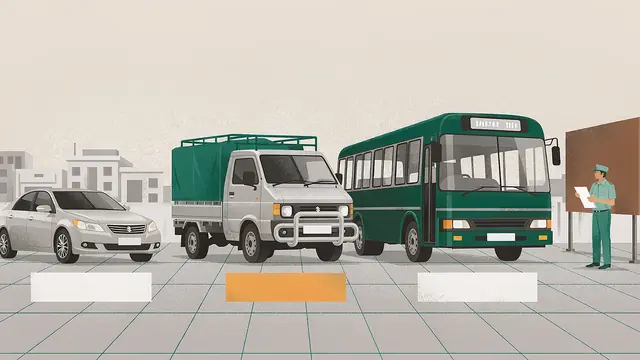
Token Tax Categories in Pakistan: Private, Commercial and Public Transport Vehicles
Token tax categories in Pakistan split private, commercial and public transport vehicles into separate provincial schedules with different annual rates.