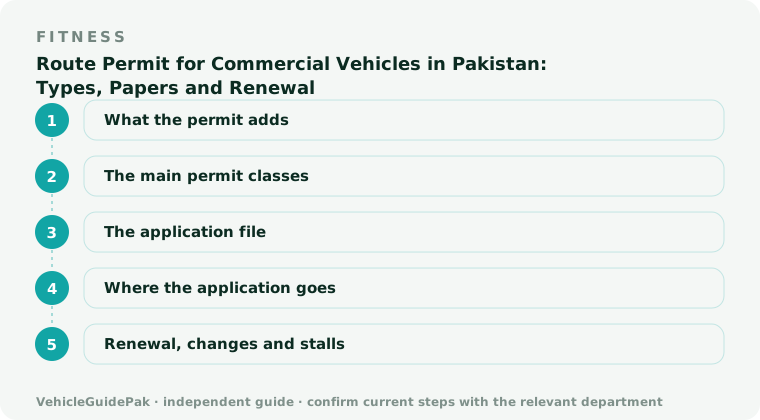


A bus, wagon, taxi, rickshaw or truck that carries people or goods for payment needs more than a registration and a fitness certificate. It needs a route permit: the authority’s permission for that vehicle to do that work on that route or in that area. Operators often sort out registration and fitness first and leave the permit until the vehicle is ready to work. This guide covers the permit classes, the application file, where it goes, and the renewal habits that keep a commercial vehicle legal.
What the permit adds
Registration records the owner and the vehicle’s identity. Fitness certifies that the vehicle is roadworthy. Insurance answers for injury and damage caused to others. The route permit defines the work: carrying passengers on a named route with stops, hiring the whole vehicle to one customer, or moving another trader’s goods.
The permit is tied to the vehicle and to the route or area printed on it. Driving outside that scope is treated as operating without a permit, even when the vehicle, driver and papers are otherwise in order. The driver also needs the right class of driving licence for a public service vehicle, which is a separate licence from the permit held for the vehicle.
The main permit classes
Provincial transport laws use a small set of categories. The names are consistent across provinces even where the forms and fees are not.
| Permit class | Typical vehicle | What it authorises |
|---|---|---|
| Stage carriage | Bus, wagon, coaster on a fixed intercity or urban route | Picking up and setting down passengers along a route, usually against a published fare |
| Contract carriage | Taxi, rickshaw, motorcycle rickshaw, rental coach | Hiring the whole vehicle to one person or group for a trip |
| Public carrier | Truck, pickup or van carrying another trader’s goods for hire | Goods transport for payment |
| Private carrier | Vehicle carrying the operator’s own goods | Own-account transport, with no hire or reward |
The class decides the paperwork and the term. Passenger permits are commonly granted for a year and goods carrier permits for a longer period, but the term is set by the issuing authority and is printed on the permit. Read it there rather than assuming last year’s term still applies.
A vehicle built or registered for one class cannot be used for another without the authority’s approval. A goods body carrying fare-paying passengers, or a private vehicle taking paid school runs, is outside its permit even if the owner calls the arrangement informal.
Who needs one
The requirement follows paid use.
- Buses, wagons, coasters and vans carrying passengers on a route.
- Taxis, rickshaws and motorcycle rickshaws available for hire.
- Trucks, pickups and delivery vans carrying other people’s goods for payment.
- Rental and staff transport vehicles, where the vehicle is provided as part of a paid service.
- Vehicles carrying the operator’s own goods, where the province requires a private carrier permit.
A private car used for the household does not need a route permit. A private car used to carry paying passengers does, and the registration class, insurance and fitness position all have to match that use. This is a common place for a small transport business to start with the wrong vehicle: a private registration bought for a passenger service, or a goods vehicle used for passengers because the route is short.
The application file
The transport authority works from documents, and a missing item sends the file back before anyone looks at the vehicle. The core set is the same in the provinces that publish a checklist.
| Document | Where it comes from | Why the counter wants it |
|---|---|---|
| Application form for the permit class | Transport authority or its portal | Identifies the vehicle, route and service |
| Affidavit | Prepared on stamp paper to the department’s sample | Confirms the applicant’s declarations |
| CNIC copy | NADRA | Matches the applicant to the registration record |
| Registration book or smart card | Excise department | Proves ownership and vehicle identity |
| Token tax proof | Excise receipt or online payment record | Shows the annual tax is clear |
| Fitness certificate | VICS station or the provincial inspection system | Shows the vehicle passed inspection |
| Third-party insurance | Insurer registered with SECP | Covers liability to other road users |
| Passenger guarantee | Insurer or bank, for intercity stage carriage applications | Protects passengers if the operator defaults |
| Fee challan | Bank or provincial biller | Proves the permit fee was paid |
The order matters. Fitness and insurance must be current on the day the file is submitted, not on the day the vehicle starts work. A certificate that expires during the application is treated as expired, and the operator starts again.
Where the application goes
In Punjab, air-conditioned vehicles are handled by the Provincial Transport Authority in Lahore, and other vehicles by the District Regional Transport Authority for the district where the vehicle operates. In Sindh the Regional Transport Authority handles the application. Khyber Pakhtunkhwa, Balochistan and the Islamabad Capital Territory run their own transport authorities with their own counters and portals.
Route allocation is not automatic. The authority considers the route, the service already available and objections from existing operators. A new permit on a busy route can take longer than a renewal, and a route with no capacity may be refused even when the vehicle and file are in order. Ask the counter which route class applies before paying the fee, because the class affects the fee and the term.
Fees are set by provincial notification and revised from time to time. Pay through the bank challan or the provincial biller named by the department, keep the receipt, and do not hand the fee to an agent who promises to complete the file.
Renewal, changes and stalls
A route permit is time limited. Apply for renewal before the expiry date. Punjab’s transport department asks for the renewal application a month before expiry and charges a late fee per month, or part of a month, once the permit has lapsed. The same pattern appears in other provinces with different amounts, so check the date on the permit and set a reminder a month earlier.
The vehicle and the permit have to stay in step. If the vehicle is sold, the permit is transferred through a separate application. If the registration number, route, vehicle class or operator name changes, the permit has to be amended before the vehicle works under the new arrangement. A duplicate is available when the permit is lost, and a copy kept in the vehicle saves a day when an officer asks for it.
Most stalled applications fail on the same points: an expired fitness certificate, token tax arrears, an insurance policy that has lapsed or is not in the department’s record, a registration still in the previous owner’s name, or a vehicle whose body does not match its registered class. Route objections and missing passenger guarantees explain the remainder.
Keep one file per vehicle with the registration card, fitness certificate, insurance schedule, token tax receipts, permit and driver licence. Check it a month before each expiry. A lapse keeps the vehicle idle while the file moves, which usually costs more than the renewal fee.